


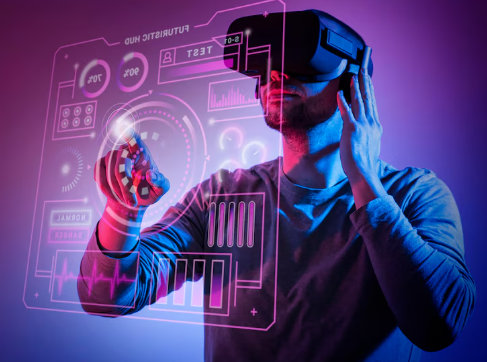
Mastering Skills On-Demand: How Augmented Reality Elevates Professional Training
In today’s fast-paced corporate environment, continuous professional development is vital. Traditional training methods, such as classroom lectures or dense manuals, often struggle to keep pace with the technical demands of modern workplaces.
Augmented reality (AR) technology is fundamentally changing this by bridging the gap between theoretical knowledge and practical application.
By overlaying real-time digital instructions, 3D models, and expert guidance onto a professional’s actual work environment, a powerful augmented reality solution creates a highly effective, context-aware, and immersive learning experience that accelerates skill acquisition and reduces operational errors.
Real-time, context-aware guidance
One of the most significant benefits of using augmented reality for professionals is the provision of “just-in-time” learning.
Instead of stopping work to consult a manual or video, technicians can wear smart glasses or use a tablet to see digital overlays—like arrows, diagrams, or checklists—superimposed directly onto the equipment they are working on.
This real-time, context-aware guidance ensures the professional has the exact information they need, precisely when they need it, leading to faster diagnosis, repair, and assembly. This approach greatly minimizes cognitive load by removing the need for memorization during complex tasks.
Risk-Free Procedural Practice
For high-stakes fields like medicine, aviation, and advanced manufacturing, making mistakes during training can be costly or dangerous. Augmented reality offers a safe, controlled environment for procedural practice.
A surgical trainee, for instance, can practice a complex operation by viewing digital overlays on a physical mannequin, or an engineer can practice repairing a delicate machine component without risking damage to the real equipment.
This ability to rehearse difficult scenarios repeatedly in a consequence-free setting builds muscle memory and confidence before the professional interacts with a live system.
Accelerating time to competency
Traditional onboarding and technical training can take weeks or months of shadowing and classroom time. Augmented reality dramatically cuts this learning curve.
New hires can be directed through step-by-step assembly or maintenance processes from day one, using visual prompts overlaid on their workspace.
Companies implementing augmented reality solutions have reported significant reductions in training time, sometimes by as much as 75%. This acceleration means new employees become productive and add value to the organization much faster than through conventional methods.
Enhanced remote collaboration and expert assistance
Augmented reality transforms collaboration by allowing remote experts to assist on-site field technicians in real time. Using AR headsets or mobile devices, a technician in one location can share a live video feed of their workspace with an expert located anywhere in the world.
The expert can then draw annotations, place virtual arrows, or share documents that appear overlaid on the technician’s field of view.
This “see what I see” capability allows senior personnel to guide complex repairs remotely, reducing travel costs and ensuring that organizational expertise is available globally on demand.
Improving Knowledge Retention and Accuracy
The interactive and multi-sensory nature of learning through augmented reality leads to demonstrably better knowledge retention. When professionals actively engage with 3D models and context-specific digital content, the learning is more memorable than passive viewing.
This hands-on, experiential learning builds deep procedural understanding. By simplifying complex procedures into clear, guided visual steps, AR drastically reduces the rate of human error, leading to higher quality of work and greater consistency across all tasks performed by the workforce.